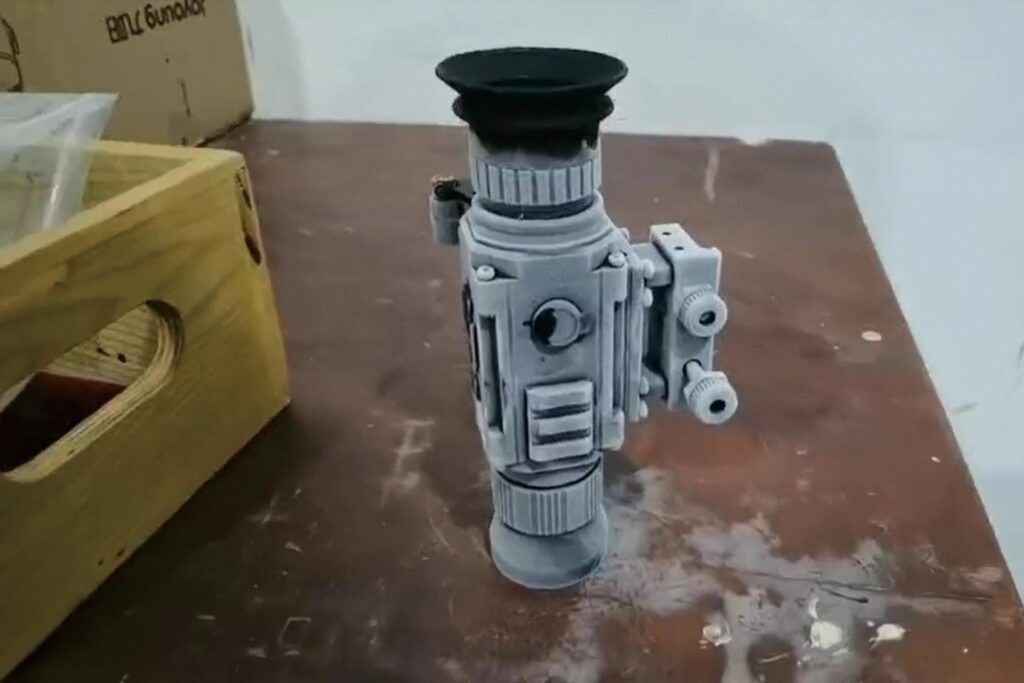

Pixel-Perfect Thermal Scopes: Our Multispectral Calibration Secret

At NP-Optics, our commitment is to build high-performance, supremely reliable thermal imaging scopes. For any aiming system, absolute precision is non-negotiable. In the world of daytime optics, the optical collimator is the universal tool for ensuring this. Yet, a fundamental barrier exists for thermal scopes: infrared light cannot pass through a standard collimator’s objective lens, rendering this essential QA process useless.

Confronting this industry-wide challenge head-on, NP-Optics embarked on an in-house R&D mission. The result is our proprietary Multispectral Boresight Collimator. This advanced instrument can simultaneously process infrared, visible, and laser wavelengths, allowing it to precisely measure the alignment—or misalignment—between the thermal sensor core, the display reticle, and the objective lens.

How This Calibration System Defines Our Manufacturing:

  1. Assembly-Level Alignment: After initial assembly of the core, eyepiece, lens, and OLED display, the unit is placed in the collimator. Components are then minutely adjusted and secured, establishing a foundation of perfect alignment before final assembly.
  2. Final Inspection Verification: Post-assembly, every scope must return to the collimator for final QA. We enforce a stringent 15-pixel tolerance standard, ensuring the reticle center deviates from the true optical axis by no more than this limit.
  3. Reliability Re-verification: Qualified units then undergo a brutal shock test: 1000 cycles at 2Hz with 700G acceleration. After this simulation of extreme recoil and impact, the scope is tested a third time. It passes only if its boresight remains steadfastly within the 15-pixel tolerance.

Extended Precision: This system also calibrates integrated laser rangefinders, ensuring the laser dot coincides exactly with the on-screen aiming point, creating a unified “range-and-aim” system.

Every NP-Optics optical device passes through this multispectral calibration gauntlet. We believe exceptional thermal image quality is the starting point. Absolute aiming reliability, built on millimeter and pixel-level precision, is the ultimate promise of a professional tool. This is the accuracy we build into every scope.

The story of NPO Top mount picatinny rail

In 2023, a deep collaboration with professional users in Eastern Europe taught us a pivotal lesson in practical design. They were using our first-generation FMR335 thermal imaging scope and came back with a specific, hardware-focused request: “We need a Picatinny rail on top.”

Initially, we wondered why. The answer revealed a critical need for tactical flexibility. In high-intensity use, constantly swapping between a daytime optic and a thermal scope is inefficient and can compromise zero. These users needed a permanent, unified weapon platform that could adapt in an instant.

Their logic was brilliant in its simplicity:

  • Mount a red dot sight on the newly added top Picatinny rail.
  • Leave the thermal scope on the main rail underneath.
  • Daylight/CQB: Use the always-ready, zero-power red dot for speed.
  • Darkness/Concealment: Flip on the thermal scope for imaging.

This configuration eliminates the “dead scope” dilemma. Imagine a coyote appears at 40 yards in broad daylight. Your rifle is equipped with this hybrid system. You raise it and the red dot is instantly live—no waiting for a thermal scope to boot. You take the shot. The top-mounted Picatinny rail just turned a specialized night-vision tool into a 24/7 ready rifle.

That user request directly shaped our product line. We now design key models with an integrated top Picatinny rail, recognizing it’s not just an accessory point but the cornerstone of a dual-purpose sighting system. It’s a testament to building what users truly need, not just what we think they want.

Explore NP-Optics thermal scopes built with user-inspired features, designed for all hunting situation adaptability.

Beyond the Battery is how we solving the thermal scope power crisis

A hard lesson echoed by professionals across modern battlefields, from Ukraine to global training grounds: a thermal scope without power is a useless piece of equipment. When the battery dies, your tactical advantage vanishes in the dark.

Even high-end military thermal scopes, typically powered by dual 18650 batteries (up to 8000mAh), struggle to exceed 8 hours of continuous use in freezing conditions. This critical limitation forces operators into vulnerable battery-swapping routines mid-operation. The reality is stark: a dead thermal scope is as good as having no scope at all.

At NP-Optics, we’ve made it our mission to break this fundamental constraint. We approach the power challenge not by merely adding bigger batteries, but through a holistic “Conserve & Augment” strategy across four key system levels:

  1. Source Efficiency: Optimized Core & Algorithms
    The infrared detector core is a major power consumer. Our proprietary high-efficiency image processing algorithms maintain exceptional image clarity while drastically reducing the computational power required, cutting energy consumption at the source.
  2. Display Revolution: Energy-Saving OLED Across the Line
    The display is another critical drain. NP-Optics has completed a full product line transition to high-performance, low-power OLED displays. These screens offer superior contrast and visibility while consuming significantly less power than traditional alternatives.
  3. External Endurance: The EPS-A1 External Battery System
    For a quantum leap in runtime, we engineered the EPS-A1 External Battery Pack. This innovative accessory securely attaches to your weapon’s Picatinny rail via a screw-clamp mount. It houses an additional set of 18650 batteries, acting as a hot-swappable backup or a parallel power source. It can even be charged in the field via a power bank, enabling “continuous use” scenarios that can more than double your operational time.
  4. Brain Power: Ultra-Efficient Hisilicon Processor
    The “brain” of our latest-generation devices has been upgraded to the HiSilicon 3356 processor. Renowned for its industry-leading power efficiency, this chip delivers formidable processing power with minimal energy draw, optimizing overall system power management.

This four-pillar approach represents a systematic war on power anxiety. Our goal is not just incremental improvement but to provide users with the confidence to operate in the most demanding conditions, free from the constant worry of a dying battery.

Reliable technology builds trust. At NP-Optics, we are committed to R&D that ensures our thermal imaging products remain your most persistent and dependable eyes in the dark.

Germanium vs. Chalcogenide: The Evolution of Infrared Optics

The foundation of modern thermal imaging technology lies in the development and application of materials sensitive to infrared radiation. Every object above absolute zero emits electromagnetic energy. Within common ambient temperatures, this emission peaks in the infrared spectrum. Specialized materials that can capture and convert this invisible signal allow us to “see” heat, forming the core of every thermal camerathermal rifle scope, and infrared monocular.

Among key infrared optical materials, Germanium (Ge) and Chalcogenide Glass are two prevalent choices, each with distinct trade-offs.

  • Chalcogenide Glass offers a significant cost advantage, typically around one-third the production cost of germanium, making it ideal for cost-effective solutions.
  • Germanium Glass provides superior stability, hardness, and mechanical strength. For large-aperture thermal scopes that must endure high recoil and harsh environments, germanium is often the unmatched material for ensuring long-term optical precision and reliability.

A critical supply chain reality now impacts the global infrared industry: Germanium is a strategic metal rarer than gold. With limited global reserves, China is the primary supplier of high-purity germanium. To maintain global strategic stability, Chinese authorities have implemented export controls on critical dual-use items, including germanium. This has, in effect, reduced the flow of germanium for military-grade infrared equipment and increased costs for germanium optics worldwide.

In response to this global supply chain evolution, NP-Optics prioritizes long-term product reliability and transparent responsibility to our customers. After careful evaluation, we announce a strategic transition plan:

Effective January 2026, we will initiate a phased transition in our infrared optical materials:

  1. For lenses 35mm and below: Upon depletion of existing inventories (180 sets of 35mm & 45mm Ge lenses), we will transition fully to high-performance Chalcogenide Glass. This manages cost while ensuring performance meets the needs of mainstream commercial products.
  2. For large-aperture lenses 45mm and above: We will gradually reduce germanium use while dedicating R&D resources to pioneer new, high-performance alternative optical materials, securing the future of our premium product lines.

We understand that material changes concern our users’ trust. This decision is not merely cost-driven but based on a comprehensive analysis of global trends, supply security, and product lifecycle. We believe thermal imaging technology is always advancing. Current challenges are driving the industry toward more diverse, innovative, and sustainable material solutions.

We communicate this plan proactively, upholding our “user-first” commitment. NP-Optics pledges that core performance and reliability standards will not be compromised during this transition. We invite you to join us as we move toward a future with even more capable thermal imaging products.

From AK to AR: The Story Behind a Thermal Scope Mount

NP-Optics’ journey in the thermal imaging scope industry began in August 2022. For over three years, close collaboration with global users, distributors, and professional shooters has provided us with invaluable firsthand experience. If there’s one fundamental lesson we’ve learned, it is this: the thermal optics market is inherently personalized and context-dependent. Different countries, different firearm platforms, and different tactical traditions create unique product requirements.

Our early product development phase offered a perfect case study.

Working with clients in Eastern Europe, we addressed a market dominated by AK-pattern rifles. The AK’s right-side charging handle and its design philosophy—which advocates for an extremely low sight axis to enhance shooter survivability—demanded a correspondingly low thermal scope mount. We successfully developed an ultra-low quick-detach (QD) mount with a mere 8mm rise. It was an elegant solution tailored for the AK platform.

However, when we took this same mount to North America for field testing, we encountered a new challenge. The dominant platform there is the AR-series rifle (e.g., AR-15, M4), which features a rear charging handle. This design requires clear space behind the scope for the shooter’s hand to operate. Our ultra-low AK mount proved problematic on the AR—it interfered with the charging handle or the shooter’s grip.

This contradiction became a catalyst for innovation. The result was our next-generation mount. Its key improvement is a significantly increased rail height. This design ensures the thermal scope can be mounted in the rearmost, most natural position on an AR platform while completely clearing the charging handle’s operational arc. Shooters no longer need to compromise on a poor cheek weld or eye relief to achieve a solid shooting stance.

This is more than a story about modifying a component’s dimensions. It encapsulates the NP-Optics design philosophy: True reliability stems from respecting details and embracing diversity. From the AKs of Eastern Europe to the ARs of North America, each adaptation represents our process of deeply understanding user scenarios and translating that insight into a superior product.

This is the profound reward and satisfaction we gain from developing deeply customized solutions for a diverse global user base.

From Custom BDC to Ballistic Calculation: A Coyote Hunter’s Request That Shaped Our Reticles

Last year, when our company was still selling thermal scopes under the Fahrentec brand on infra-optics.com, we received an email from a customer in the United States. He was a professional coyote hunter preparing for a predator hunting competition. He needed a custom Bullet Drop Compensating (BDC) reticle for his 5.56mm rifle.

Our engineering team worked for a week to develop a precise BDC reticle calibrated for the 5.56x45mm round. We sent him the updated reticle file via email. He then connected his thermal scope to his computer, uploaded the file via our software, and instantly had a personalized aiming solution. This specific 5.56 BDC reticle was later released as a standard update for all our FMR335L and FMR645L thermal scopes, a legacy that continues in our current Rhino series thermal scopes.

For a BDC reticle to work with a laser rangefinder, you need the correct caliber (e.g., 5.56mm, 7.62mm) and bullet length. While simple, this highlights the BDC’s limitation: it’s a fixed solution for one specific load under ideal conditions.

This is why we integrated a modern ballistic solver into our latest-generation Rhino thermal scopes. This system transcends simple BDC reticles.

To use the ballistic calculator, you input comprehensive data: not just caliber, but also drag function, ballistic coefficient, zero range, sight height, bullet weight, altitude, muzzle velocity, and temperature. Once configured, you activate the built-in laser rangefinder. The scope’s computer instantly calculates the solution and displays a red, dynamic holdover point directly on your reticle’s vertical axis for the exact distance measured.

It’s not a fixed mark on display screen—it’s a smart, real-time firing solution. This technology effectively places a precision-calculated aiming point on your target, transforming complex long-range ballistics into a simple point-and-shoot experience.

What Matters When Selecting a Quality Thermal Goggle?

When you think of thermal imaging, a handheld monocular or a rifle scope might come to mind. But for missions requiring mobility, situational awareness, and both hands free, the thermal goggle is the ultimate tool. It’s not just a device you look through; it’s a vision system you wear, enhancing your entire perceptual capability in darkness for heat signature searching.

Unlike a handheld thermal imager, a thermal imaging goggle is typically helmet-mounted, providing a seamless, heads-up display. This hands-free operation is critical for professionals navigating complex terrain, operating equipment, or needing immediate weapon readiness. The latest systems, like binocular thermal goggles, offer an even greater advantage: stereoscopic depth perception. By presenting a slightly different image to each eye—much like human vision—they allow for intuitive judgment of distance and size, a crucial factor in fast-moving scenarios.

So, who relies on this technology? The applications are diverse:

Security & Tactical Teams: For covert surveillance, perimeter patrols, and dynamic entries where lighting is impossible or would compromise the mission.

Search & Rescue (SAR): Navigating disaster zones or wilderness at night, where the ability to see heat signatures through smoke, fog, or foliage while keeping hands free for climbing or aiding victims is paramount.

Industrial & Wildlife Monitoring: For inspectors or researchers needing prolonged, comfortable observation of equipment or animal behavior in total darkness.

In selecting thermal goggle devices, the most critical metrics when choosing a helmet-mounted thermal device are refresh rate, field of view (FOV), and display resolution.

Earlier this year, while testing such products in the US, my friend Thomas let me try an early-generation Iray thermal monocular. As someone accustomed to modern helmet-mounted thermal systems, I experienced dizziness after just over a minute of relying on it to navigate while walking. Furthermore, I noticed that once I focused on a target person in the view, all background details were flattened and lost their depth and texture. When Thomas waved his arm in the darkness, his motion exhibited pronounced smearing or ghosting.

This was a legacy device with a 50Hz refresh rate, a 384-resolution thermal detector, and an 800×600 display. I swtiched to the latest NPO night wolf 616 thermal monocular, all in a sudden, the uncomfortness and dizziness all disappared.

This served as a perfect—and rather clever—demonstration from Thomas of the profound significance of these three core parameters and a vivid testament to how far the technology has advanced since then.

Ready to experience the world of hands-free thermal vision? Explore NP-Optics’ advanced thermal goggle solutions designed for the demands of professionals who cannot afford to be left in the dark.

Thermal scope sun damage

Sunburnt is a permanent damage to your thermal scope

Recently we received more and more feedback and aftersales services require along with the hunting season started. Amongst all those after sales cases, there are a lot caused by sunburnt. So we think we need to write this article to tell you that your thermal scope is a powerful tool for seeing heat in the dark. But it has one critical, irreversible enemy: the sun.

Unlike your eyes or a camera, the microbolometer sensor inside your scope is designed to detect very subtle amounts of infrared heat emitted by objects. The sun is an incredibly intense source of both light and infrared radiation, so that’s what you need to watch out during hunt.

Because when you point the lens directly at the sun, that massive influx of concentrated infrared energy overloads the delicate sensor’s pixels almost instantly. This causes a permanent burn-in on the focal plane array (FPA).

The result is a fixed, bright spot or line permanently etched into every image you see from that moment on. This damage is not a software glitch or a setting error—it is a physical, irreparable hardware failure. The sensor cannot be “recalibrated” or healed.

In order to avoid such damage we want to give you 3 advices:

1. Never, under any circumstances, point your thermal scope at or near the sun, even for a second. Treat it with the same absolute caution as you would when using magnified optical optics.

2. Be Vigilant During Daytime: Exercise extreme care when handling, transporting, or storing your scope during the day. Always keep the lens cap on when not in active use.

3. Mind the Surroundings: Avoid scanning near the horizon at sunrise or sunset, where the sun may be just out of frame but still flood the sensor with diffuse glare.

After all we want you to know that sensor damage is the leading cause of non-warranty repairs. Protecting your scope from the sun is the single most important step in ensuring its long-term performance and your investment.

Stay safe, and hunt smart.

Are you ready to choose the best thermal scope for this hunting season?

The cover of darkness no longer offers game a free pass. Thermal imaging technology has revolutionized night hunting, allowing you to detect, identify, and engage targets in total darkness. But with a range of options on the market, how do you choose the best thermal scope for your specific hunting style and budget?

At NP-Optics, we’re not just manufacturers; we’re hunters and technologists. This guide will walk you through the key factors to consider, helping you make an informed decision and dominate the night.

Key Factors in Choosing a Thermal Hunting Scope

1. Sensor Resolution: The Foundation of Clarity

Recently my customer from Virginia told me, in one coyote hunt, he was with 3 guys with different thermal scope, 1 is 640 resolution, 1 is 1280 resolution, and another guy carried an Iray 384 resolution thermal scope just like his. He felt embarrassed when he saw the numbers of his fellows’ thermal scope are bigger than his, but he asked me what is behind these numbers and dollars?

To understand these numbers the easiest way is to think of resolution as the number of pixels in your thermal image. A higher resolution means a sharper, more detailed picture, making it easier to distinguish between a branch and a coyote at longer distances. Still too complicated?

Well let’s start with 384×288: the most popular model, and a good entry-level resolution, suitable for shorter-range hunting (under 200 yards) and identifying larger game like hogs.

And for the 640×512 (The Sweet Spot): This is the industry standard for serious hunters. It provides excellent detail for recognizing the signature of heat of a fox or coyote beyond 300 yards. That is why all of NP-Optics’ high-end models, like the Rhino645L and Wukong series, feature 640×512 sensors.

Then the dream maker 1280×1024 (High-End): Offers exceptional detail but at a premium price.

2. Detection Range vs. Recognition Range: what’s the difference?

This is a critical distinction I know many beginners miss.

Detection Range: The distance at which you can see “something” is there—a bunch of hot pixels showing a blurry heat signature. All scopes advertise a long detection range.

Recognition Range: This is the distance at which you can clearly identify *what* that something is (e.g., “that’s a coyote, not a fox”). This is where sensor resolution and lens quality truly matter.

Pro Tip: For ethical hunting of predators like coyotes, your effective range should be based on your recognition range, not just detection.

3. Magnification & Lens: see target closer

The lens (measured by its focal length, e.g., 35mm, 45mm) determines the base magnification and field of view.

Lower Magnification (e.g., 2-4x): gives wider field of view, perfect for scanning thick brush and fast-moving targets at closer ranges.

Higher Magnification (e.g., 4-16x): gets narrower field of view, ideal for open fields and long-range precision shots.

Our Rhino Series offers models with different lenses to suit your needs, from the standard 35mm to the long-range 45mm.

4. NETD: The Secret to Image Quality

NETD (Noise Equivalent Temperature Difference) is one of the most important yet overlooked specs. Measured in millikelvins (mK), a lower NETD value means a smoother, cleaner, and more sensitive image. It’s the difference between a grainy, “noisy” picture and a crisp, defined one.

< 40mK: Good.

< 30mK (Like our Rhino645 model): Excellent. This high sensitivity allows you to see subtle temperature differences, making it easier to pick out well-camouflaged game against a cool background.

5. Durability & Ergonomics: Built for the Field

Your thermal scope is a vital piece of hunting gear and must withstand the following matters:

Recoil handling: It must handle the repeated shock of your rifle’s caliber. NP-Optics scopes are rigorously tested to withstand 800-1000G of recoil shock.

Water proofing: IP67 is what you need, which guarantees complete dust ingress protection and the ability to be submerged in water. I had bad experience when driving, walking, waiting for the whole night then have to come back just because the bad quality scope does not work after rain drop on it.

Battery life: A long hunt requires a long-lasting power source. Our Rhino335L, for example, offers up to 10 hours of continuous use on a single charge. Also, the external power compatibility is greatly helpful when you only have power banks left.

NP-Optics: Engineered for the Demanding Hunter

Understanding the specs is one thing, seeing how they translate to a real-world advantage is another. Here’s how NP-Optics scopes are built to perform when it matters most.

Shutterless Technology: Never experience a frozen image or loud “click” during a critical moment. Our advanced AI algorithms provide a seamless viewing experience, allowing for fast target acquisition as you swing your rifle. This is a game-changer for fast-paced predator hunting.

Rugged Magnesium Alloy Housing: We use lightweight yet incredibly strong magnesium alloy housings. This provides superior strength and durability without adding unnecessary weight to your rifle.

Real-Action Proven: Don’t just take our word for it. Watch the Coyote hunting with Rhino645L thermal scope video on our channel to see the clarity and reliability in action.

Conclusion: Making Your Choice

The “best” thermal scope is the one that fits your specific hunting environment, target game, and budget.

For all-around predator control (coyotes, foxes) in varied terrain, a 640 sensor with a 45mm lens (like the Rhino645L) is an excellent choice. For budget-conscious hunters who still demand quality, our 384 Matrix products offer a fantastic entry point with proven NP-Optics durability.

Ready to Own the Night?

Coyote hunting with Rhino645L thermal scope

This real-world footage, captured by a hunter in the US, demonstrates the accuracy of our thermal imaging scope in action. From 130 meters away, the clean and precise takedown of a coyote in total darkness speaks for itself.

This isn’t just a video; it’s proof of the clarity and reliability our technology delivers when it matters most.

Watch the video below to experience the advantage for yourself.