

In coyote and wild hog hunting, these animals are often active at night. Hunters may use thermal scopes to detect heat signatures in complete darkness, but locating a target is only part of the process. Moving through the dark, setting up equipment, and preparing a hunting site can also take considerable time.
Using ordinary lighting during these activities may alert game to a hunter’s presence and reduce the chances of a successful hunt. Night vision devices can help hunters navigate in darkness and prepare their equipment without relying on visible light.
However, night vision devices vary considerably in price and performance. Different imaging technologies, sensor specifications, processors, algorithms, and optical systems all influence the final image.
To better understand these differences, Novelty Point Optics established a dedicated low-light laboratory and conducted a series of comparative tests. Our goal was to examine the actual low-light imaging capabilities of several night vision devices and explore how their performance relates to their price.
1. Two Main Night Vision Technologies: Image Intensifier Tubes and CMOS
Modern night vision devices commonly use one of two imaging approaches: image intensifier tubes or digital CMOS sensors.
Image intensifier night vision amplifies available light to produce a visible image. Image intensifier tubes are commonly categorized using specifications such as Figure of Merit (FOM). In the market, buyers may encounter ratings including FOM 1400, FOM 1600, FOM 1800, FOM 2000, and FOM 2200.
Monocular head-mounted night vision devices using these tubes can start at approximately $1,400 and exceed $2,500, depending on the tube and overall system configuration.
Digital CMOS night vision, by comparison, uses an image sensor together with electronic processing to produce a visible image. Its performance depends on the sensor, processor, image-processing algorithms, lens, exposure settings, and other system characteristics.
Digital night vision products can range from approximately $400 to $1,500. However, products within this price range can deliver very different low-light performance.
To investigate these differences, we selected four devices or imaging modules for testing.
2. Our Low-Light Laboratory Test Setup
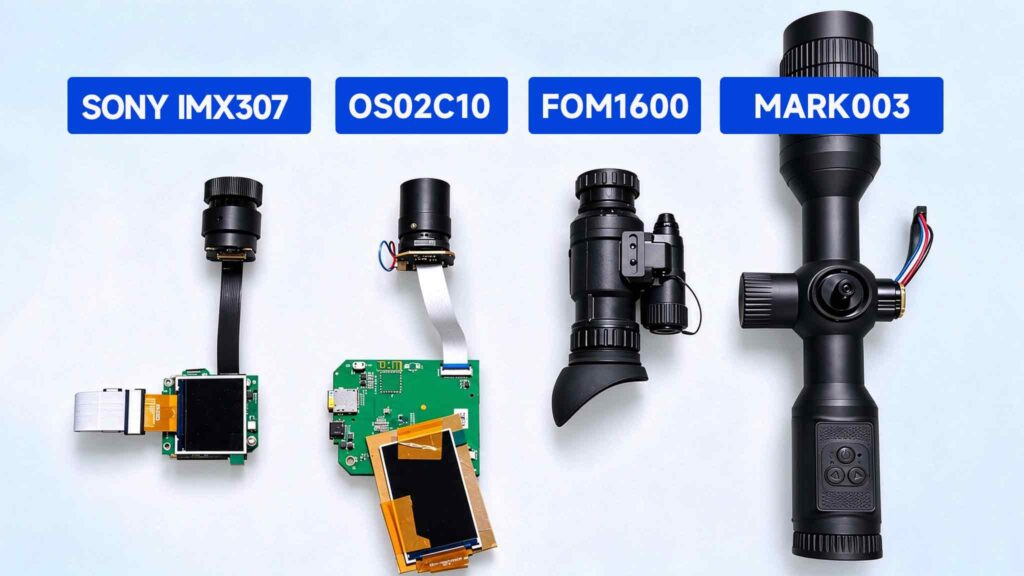
The experiment included four night vision systems:
- A Novelty Point Optics Glimfinder14 monocular night vision device equipped with an FOM 1600 image intensifier tube.
- A digital night vision module equipped with a Sony IMX307 CMOS sensor.
- A digital night vision module equipped with a Chinese-developed OS02C10 CMOS sensor and a Huawei HiSilicon processor.
- A digital night vision riflescope under development, equipped with a Chinese-developed CMOS sensor, a Huawei HiSilicon processor, and a 50 mm focal-length objective lens.
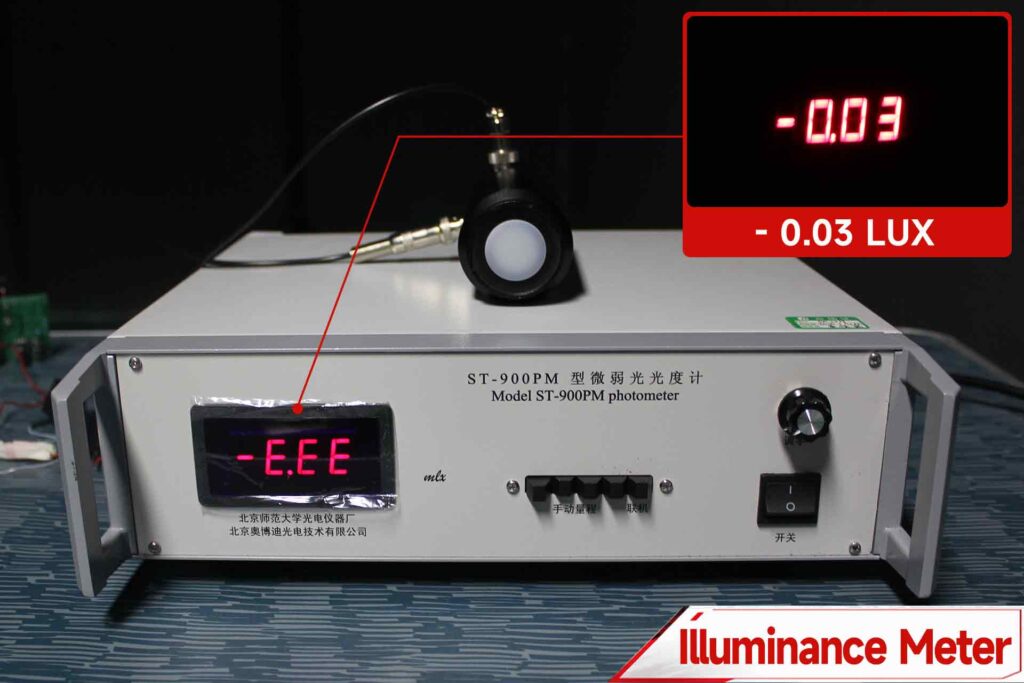
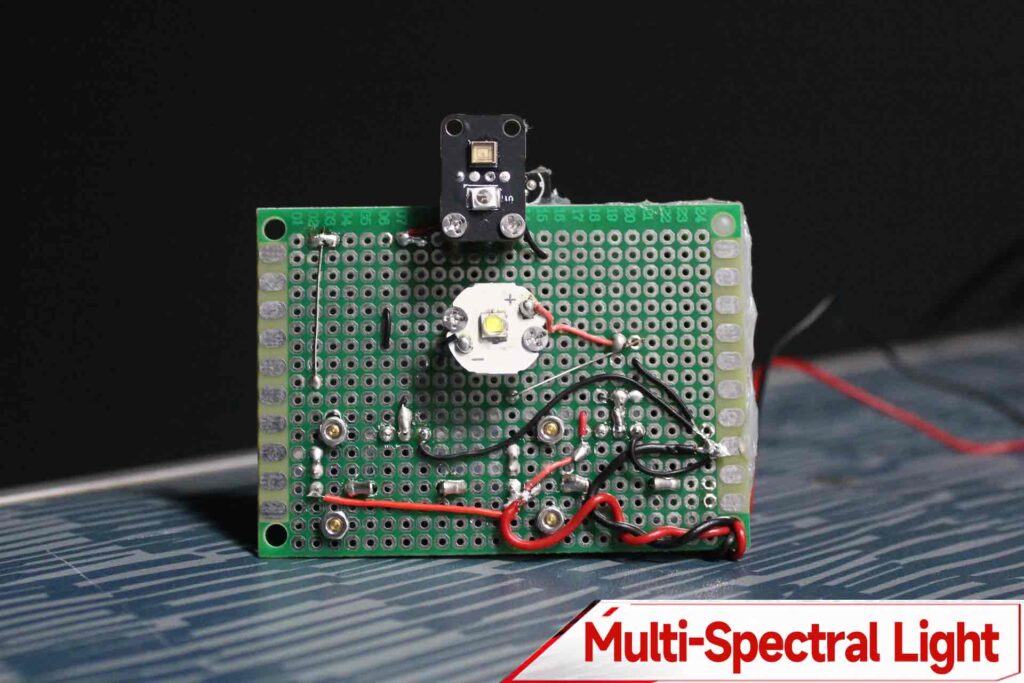
The target was positioned at a distance of 5 meters. We used a multispectral illumination system supporting LED, infrared (IR), and laser illumination to provide controlled lighting. A domestic Chinese illuminance meter was used to monitor the illuminance levels during the experiment.
Mr. Zhao, our technical director, was responsible for operating the test equipment and conducting the experiments.
For the initial comparisons, we evaluated whether each system could still resolve details or distinguish the overall outline of the target without IR illumination.
The following results represent observations under our specific laboratory conditions. They should not be interpreted as universal minimum-illumination specifications for every configuration using the same sensor or imaging technology.
3. Test One: Glimfinder14 FOM 1600 Image Intensifier Night Vision
Our first test subject was the Novelty Point Optics Glimfinder14 monocular night vision device, equipped with an FOM 1600 image intensifier tube.
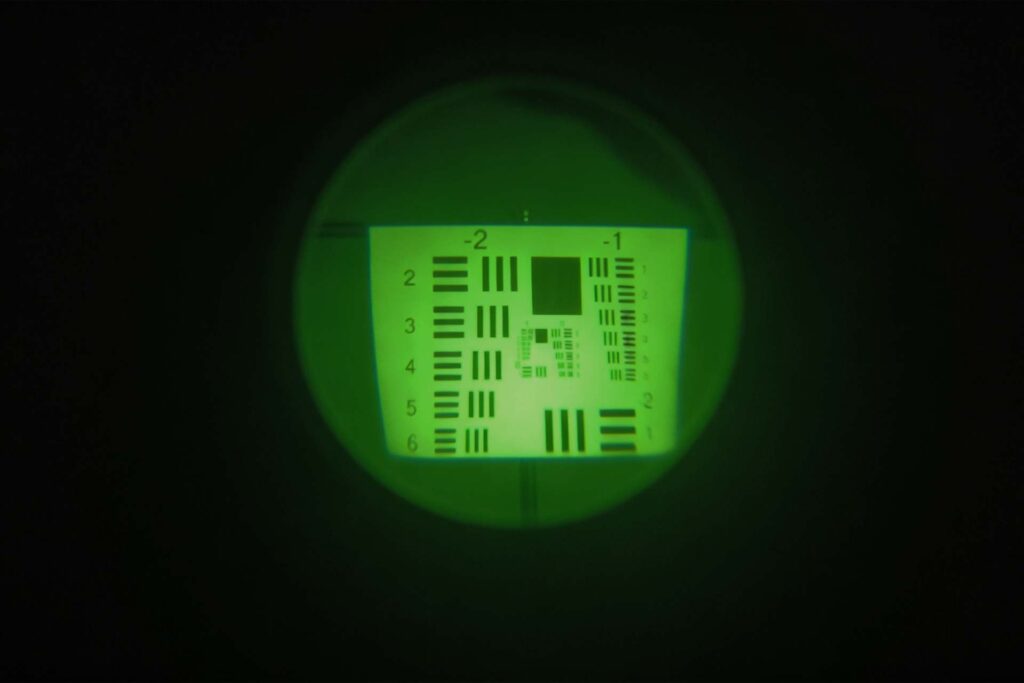
When the laboratory illuminance was adjusted to 0.02 lux, the device could still resolve details in the target pattern without IR illumination.
As illuminance decreased to 0.006 lux, the device could distinguish the general outline of the target, although its ability to resolve fine details was reduced.
These observations demonstrate the difference between recognizing an object’s overall shape and resolving its finer features.
Under our experimental conditions, the Glimfinder14 retained useful imaging capability at illuminance levels in the order of 10⁻² lux for detail recognition, while outline recognition remained possible at approximately 0.006 lux.
It did not achieve a 10⁻³ lux test condition in this experiment.
This distinction matters because a device may allow a user to recognize that an object is present without providing enough detail to identify its specific features.
4. Test Two: Sony IMX307 Digital Night Vision
The second test subject was a digital night vision module equipped with a Sony IMX307 CMOS image sensor.
Although the IMX307 is an earlier-generation sensor, it has been widely used in digital imaging applications. Its 1/2.8-inch optical format and 2.9 μm pixel size make it a useful reference point for comparing digital night vision systems.
Without IR illumination, the module could still display part of the target pattern and its overall outline at 1.3 lux.
When illuminance decreased to 1.2 lux, the image became difficult to recognize under our test conditions.
The observed transition between these two lighting levels provides a practical reference for this particular module and configuration.
Digital night vision products using the IMX307 have commonly occupied the lower-to-middle price range of the market. For the products considered in our comparison, typical prices were approximately $400 to $650.
However, sensor specifications alone cannot determine the performance of a complete night vision device. Lens aperture, exposure time, gain settings, noise reduction, and image-processing algorithms can all affect the final image.
For this reason, we used the IMX307 module as a reference system rather than assuming that every product using this sensor would produce identical results.
5. Test Three: OS02C10 CMOS with a Huawei HiSilicon Processor
Our third test subject combined a Chinese-developed OS02C10 CMOS image sensor with a Huawei HiSilicon processor.
The detector has a 1/2.8-inch sensor format and a 2.9 μm pixel size, matching the nominal format and pixel size of the IMX307 used in our second test.
According to the specifications available to us, the OS02C10 configuration has an SNR1s figure of 0.16 lux. The system also incorporates a more advanced image-processing solution.
In our laboratory experiment, this module reached an observed imaging threshold of approximately 0.3 lux.
Compared with the IMX307 module, which became difficult to recognize at around 1.2 lux, the OS02C10 system produced a recognizable image under substantially lower illuminance in our test.
The result was particularly interesting because the OS02C10-based solution was approximately 30% less expensive than the IMX307-based solution in the configurations we compared.
This finding suggests that a newer sensor and a well-matched processing solution can potentially deliver better value than a more expensive alternative.
It is important to note, however, that this was a comparison between complete imaging configurations, not an isolated measurement of the two sensor chips. Differences in processing, exposure settings, optical components, and other system parameters may contribute to the observed results.
6. Test Four: A Digital Night Vision Riflescope Under Development
Our final test subject was a digital night vision riflescope currently under development.
Its main specifications include:
- Objective lens: 50 mm focal length
- Sensor format: 1/2-inch
- Pixel size: 4 μm
- Image sensor: Chinese-developed CMOS detector
- Image processor: Huawei HiSilicon
- Target price: Approximately $1,000
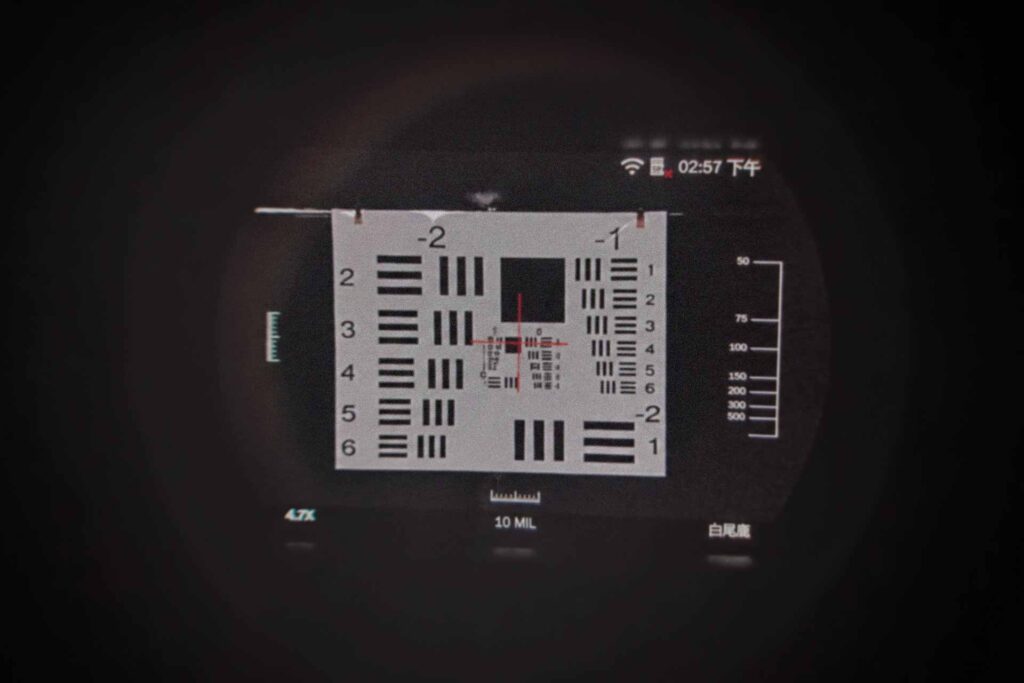
In our laboratory experiment, this system achieved an observed imaging threshold of approximately 0.06 lux.
This was the lowest illuminance threshold among the four tested systems in our comparison.
The larger sensor format, different pixel size, 50 mm objective lens, and image-processing system all contribute to the overall imaging configuration. Therefore, the result should be understood as the performance of the complete system rather than proof that any one component alone determines the outcome.
Nevertheless, the result demonstrates the potential of combining a suitable optical system, a larger-format sensor, and effective image processing to improve digital night vision performance.
For a product targeting the approximately $1,000 price range, this is an encouraging development result.
7. Low-Light Night Vision Test Results at a Glance
The following table summarizes our observations during the laboratory experiment.
| Tested system | Observed result without IR illumination | Price information |
|---|---|---|
| Glimfinder14, FOM 1600 | Fine details at 0.02 lux; overall outline at 0.006 lux | Approximately $1,400–$2,500+ for comparable image-intensifier devices |
| Sony IMX307 module | Part of the pattern and overall outline at 1.3 lux; image difficult to recognize at 1.2 lux | Approximately $400–$650 for the products considered |
| OS02C10 + HiSilicon | Observed imaging threshold of approximately 0.3 lux | Approximately 30% lower than the IMX307-based configuration compared |
| CMOS riflescope under development | Observed imaging threshold of approximately 0.06 lux | Target price approximately $1,000 |
Important: These are observations from our specific test configurations, not standardized ratings for all products using the same sensors or technologies. The tested devices differ in their optical and electronic configurations, and the price figures refer to the products or configurations described above.
The results also illustrate why image quality should not be judged by a single number. Recognizing an object’s outline, resolving fine details, and producing a clean, stable image are different performance requirements.
8. What Do These Results Mean for Night Vision Buyers?
Our experiment highlights several important considerations when choosing a night vision device.
First, price alone does not determine low-light performance.
A more expensive product may offer better performance, but the relationship is not necessarily linear. The OS02C10-based system in our test delivered better observed low-light performance than the IMX307-based module at a lower price.
Second, sensor specifications are only part of the equation.
The sensor, processor, image-processing algorithms, lens, exposure settings, and overall optical design work together. A strong sensor specification cannot guarantee excellent real-world imaging if the rest of the system is poorly matched.
Third, digital night vision should not be treated as one uniform category.
Two digital night vision devices can use different sensors, processors, lenses, and algorithms, resulting in very different images. Buyers should evaluate the complete device rather than relying solely on the words “digital night vision” or the name of its sensor.
Finally, the intended application matters.
For hunters who need to move in darkness, prepare equipment, or navigate around a hunting site, practical low-light visibility may be more important than a headline specification. The ability to distinguish objects and recognize relevant details under the actual operating conditions should guide the purchasing decision.
Conclusion: Look Beyond the Price Tag
At Novelty Point Optics, we believe meaningful product development begins with testing, measurement, and an understanding of real user requirements.
Our low-light laboratory experiment demonstrated substantial differences among the four tested night vision systems. It also showed that the relationship between price and performance depends on more than the imaging sensor alone.
The image intensifier, CMOS detector, processor, algorithms, and optical system must all work together to produce useful night vision performance.
For consumers, the lesson is simple: look beyond the price tag and headline specifications. Evaluate how the complete device performs under the lighting conditions that matter to you.
For our engineering team, the experiment provides valuable information for continued product development and optimization. By combining laboratory testing with practical application requirements, we aim to develop night vision products that deliver a meaningful balance of performance, reliability, and cost.
At Novelty Point Optics, we will continue to test, measure, and refine our optical products to turn engineering improvements into practical benefits for our customers.