

Last week, Novelty Point Optics successfully shipped a Palm625 handheld thermal imager sample to a customer in New Zealand, marking our first collaboration with a channel partner in the country.
Although it was a small sample order, it received special attention and full support from our entire team. After in-depth discussions with the customer and careful consideration of local outdoor conditions, we recommended the Palm625 as a suitable solution for thermal observation in New Zealand.
New Zealand is known for its mountains, hills, grasslands, and diverse outdoor environments. With relatively limited flat terrain, many observation scenarios are within approximately 800 meters. In cool and humid conditions, particularly during the early morning and evening, thermal imaging performance can also be affected by environmental conditions.
The Palm625 handheld thermal imager is equipped with a 640×512 infrared detector and a 25mm focal-length lens, combined with digital zoom for flexible target observation. Its NETD is as low as ≤35mK, providing strong thermal sensitivity and helping maintain useful thermal contrast in challenging conditions such as cool, humid mornings and evenings.

For these reasons, we believe the Palm625 is one of the most suitable handheld thermal imaging products in our current lineup for this type of outdoor environment.
Built for Practical Outdoor Thermal Observation
When selecting a handheld thermal imager for outdoor use, image performance is only part of the equation. Comfort, portability, reliability, and the ability to use the device for extended periods are equally important.
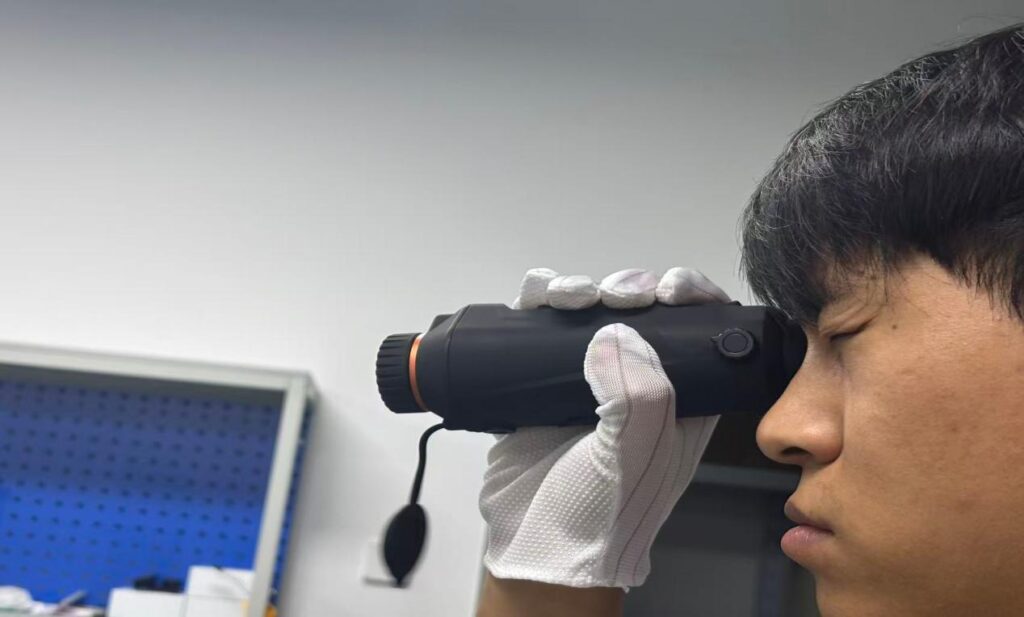
Before shipment, our technical team conducted a thorough inspection and functional verification of the Palm625 sample to ensure that the customer could use the device immediately upon arrival.
The eyepiece is equipped with a flexible silicone rubber eye cup designed to fit comfortably around the eye socket. It helps block stray light from the sides that could interfere with the viewing experience while reducing pressure around the eye during prolonged observation.
This is particularly important for users who spend extended periods scanning outdoor environments through a thermal monocular.
Compact Size and Lightweight Magnesium Alloy Housing
The Palm625 is designed to fit naturally in the palm while remaining lightweight enough for extended field use.
Its integrated die-cast magnesium alloy housing weighs only 62.4 grams, while the complete device weighs approximately 260 grams.
A supplied lanyard allows users to securely attach the thermal imager to their wrist, while the compact body can easily fit into a shirt or jacket pocket.
For hunters and outdoor enthusiasts who need to carry their equipment over long distances, this lightweight and compact design makes the Palm625 a practical handheld thermal imager for hunting and outdoor observation.
Carefully Prepared for Shipment
We also paid particular attention to the packaging and accessory configuration for this sample shipment.
The Palm625 comes in a premium black rigid gift box with a precision-molded high-density foam insert. The foam securely holds the device in place and provides protection against impact and compression during transportation.
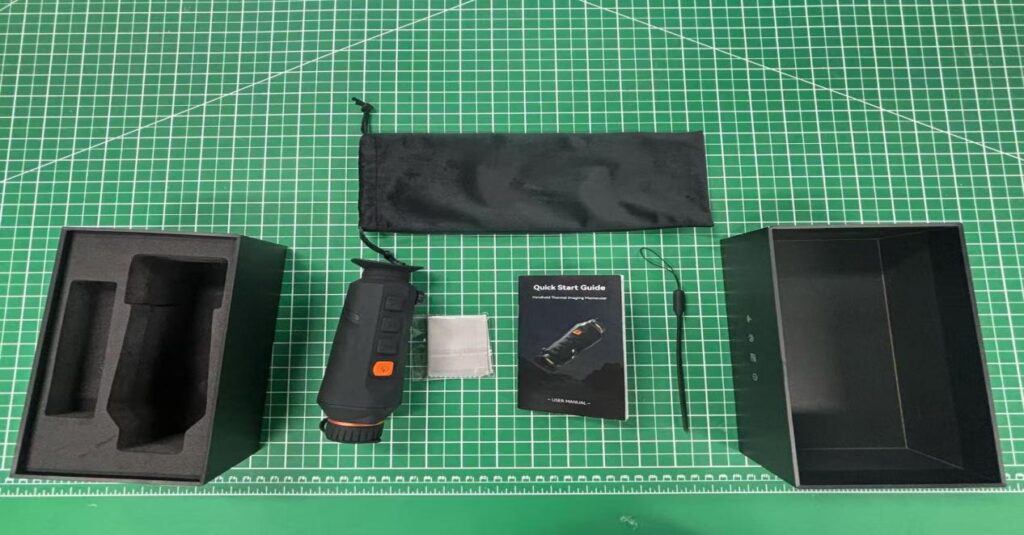
The standard accessory package includes:
- Palm625 handheld thermal imager
- Black velvet drawstring storage pouch
- Official quick-start guide
- Spare lens sealing gaskets
- Anti-loss lanyard
We believe that a professional thermal imaging product should arrive ready for use, with the essential accessories properly organized and protected.
Why 640×512?
The Palm625 uses a 640×512 thermal detector, providing a higher level of image detail compared with lower-resolution thermal imaging systems.
For outdoor observation, higher detector resolution can provide additional detail when identifying thermal targets and evaluating scenes at different distances.
The choice between 384×288 and 640×512 thermal imaging depends on factors such as observation distance, lens selection, target size, budget, and intended application. For users interested in understanding the practical differences between these two resolutions, our 384 vs. 640 thermal scope buying guide provides a more detailed comparison.
A New Market for Palm625
This shipment to New Zealand represents more than just another sample order for us.
It is our first collaboration with a channel partner in New Zealand and an opportunity to better understand the requirements of customers in the Southern Hemisphere.
Every market has its own environmental conditions, user habits, and application scenarios. By communicating directly with customers and understanding how they actually use thermal imaging products in the field, we can continuously improve our product recommendations and future product development.
For Novelty Point Optics, this is also part of our approach to product development: listen to users, understand real-world applications, and develop optical products around practical needs.
The Palm625 is only one example.
As we continue working with outdoor professionals, hunters, distributors, and brand partners around the world, we hope to bring more practical thermal imaging solutions to different markets.
The journey of Palm625 into New Zealand is just beginning.