

When choosing a thermal scope, many hunters only look at the resolution numbers but do not understand the meaning behind those numbers. As a result, they often find themselves struggling over the “384 vs 640” question. Today, we are here to give you a complete and correct explanation of thermal scope resolution once and for all, so that you can get a clear answer based on your own needs.
First, we need to understand that numbers like 640×512 and 384×288 represent infrared detectors with different array sizes. Based on optical principles, each has its own strictly defined optimal application scenario. If you choose the wrong parameters, a hunter will either spend extra money on a high-end configuration that they cannot make use of, or pick a lower-end one that fails to achieve the desired long-distance requirement. Below, we will explain the principles clearly, and then use the real-world cases of two customers to give you the best guide for choosing between 384 vs 640.
To make it easier to understand, we have created an optical path comparison diagram. The upper and lower paths show how a 384×288 detector and a 640×512 detector perform at the same target distance and with the same objective lens focal length — specifically, their FOV performance and signal reception.
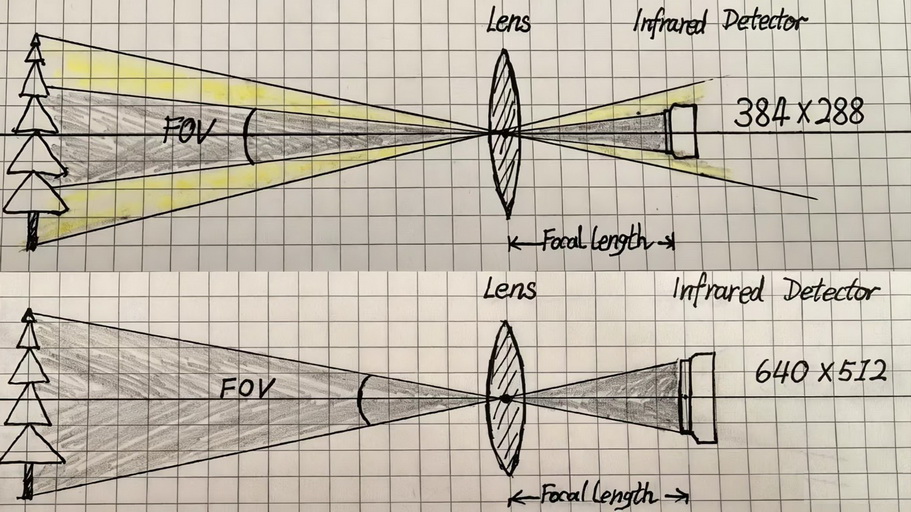
At the same focal length, the 640×512 detector array at the bottom can fully receive all the light signal projected by the distant target through the objective lens. In contrast, the effective area of a 384×288 detector is only about half the size of the 640×512 detector, so it can only capture part of the light signal projected by the target. More of the light signal, after passing through the objective lens, falls outside the 384×288 array. In other words, pairing a small detector with a large lens is a waste. The role of lens focal length is very direct: the longer the focal length, the higher the magnification and the stronger the long-range detail resolution, making it suitable for locking onto small targets at ultra-long distances; the shorter the focal length, the wider the field of view, making it faster for close-range scanning and more flexible for tracking. However, the lens must be perfectly matched with the corresponding detector resolution in order not to waste optical performance.
On the question of how to choose between 384 and 640 thermal scopes, two of our users made completely different choices.
Tommy lives in Virginia and has four years of coyote hunting experience. He hunts year-round in the hilly, densely forested areas of the Appalachian Mountains, where there is a lot of terrain obstruction and his effective shooting distance is consistently within 200 meters. All his shooting techniques and habits are built around short-range precision. He told me that for shooting needs within 200 meters, the pixel density of 384 resolution is completely sufficient—the image is clear with no pressure, and there is no need for a higher pixel count. Paired with a 35mm or 42mm standard focal length lens, it perfectly matches the small array of the 384, utilizing 100% of the lens performance. The field of view is suitable for fast searching in dense woods, the body is lighter, and the battery life is longer. Within a 200-meter shooting range, there is no noticeable difference in image quality between a 384 setup and a 640 setup. Choosing 640 would be completely overkill and unnecessary expense. Therefore, he chose our Rhino335L thermal scope and is very satisfied with it.
Now look at Bob, who also has four years of hunting experience, but his scenario and needs are completely different. Bob hunts wild hogs on the open plains of Texas — no obstruction, wide-open FOV, and 300 to 400 meter long-distance shooting is routine for him. He told us that the core needs for killing wild hogs in Texas are to see far, identify clearly, and lock onto target details at long distances. At this distance, the inherent shortcomings of the 384 detector cannot be overcome. Even if forcibly paired with a long focal length lens, the array size is too small, wasting lens performance. The long-distance image becomes pixelated, target outlines are blurry, and details cannot be judged, directly affecting hit probability. The larger sensing array of the 640 detector can perfectly match a long focal length lens, fully receiving all the imaging light from the lens and fully utilizing the long-distance resolving power of the long lens. At distances of 300 to 400 meters, it still delivers a sharp and detailed image, allowing precise locking onto the silhouette and posture of a coyote. For Bob, 640 product like our Rhino645L is not a premium up-sell; it is a necessity for long-distance hunting. No matter how large a lens you pair with a 384 setup, it cannot meet his real-world needs.
To sum up: for short distances, use 384×288 paired with a short focal length lens — best value, practical and sufficient. For long-range open plains, choose a long focal length lens paired with a 640×512 infrared detector — you can see far and have a wider field of view(FOV). Now, on this question of 384 vs 640, do you have your answer?
Choose 384 If:
- budget limited
- short range hunting
- beginners
Choose 640 If:
- long distance hunting
- professional predator control
- better detail needed