

Red dot sights have become one of the most popular aiming systems for modern rifles. Their simplicity, fast target acquisition, and ease of use make them ideal for hunting, sport shooting, and tactical applications.
At first glance, an LED red dot sight and a holographic sight appear to perform the same function. Both project an illuminated aiming point that allows shooters to engage targets quickly and accurately.
However, there is one question that confuses many buyers:
Why does an LED red dot sight often cost only $30–$100, while a holographic sight may cost $500–$700 or even more?
What exactly are you paying for?
As a manufacturer involved in the development and testing of both LED red dot sights and holographic sights, we would like to explain the real technical differences behind these two systems.
What Is an LED Red Dot Sight?
An LED red dot sight uses an LED or OLED light source to generate a reticle that is reflected onto a specially coated lens.
The structure is relatively simple, which is one of the main reasons LED red dots are affordable, compact, and energy efficient.
Modern LED red dot sights offer several important advantages:
- Low manufacturing cost
- Compact size and lightweight construction
- Extremely long battery life
- Multiple reticle patterns
- Multiple reticle colors
- Easy customization
One major advantage of LED technology is reticle flexibility.
Because the reticle is generated electronically through an LED matrix, manufacturers can create multiple reticle designs within a single optic. Depending on the product, users may switch between:
- 2 MOA Dot
- Circle Dot
- Crosshair
- Green Dot
- Red Dot
Different combinations of LED matrix elements can generate various reticle shapes and colors, providing significant flexibility for different shooting applications.
Another important advantage is power consumption.
Because LED systems require very little energy, many sights can operate continuously for over 50,000 hours using a small button-cell battery. The small battery compartment allows manufacturers to build optics that are lighter, smaller, and easier to mount on compact firearms.
What Is a Holographic Sight?
A holographic sight uses a laser projection system and holographic film technology to reconstruct a reticle image that appears projected at a great distance from the shooter.
Unlike an LED red dot, which reflects an image from a lens surface, a holographic sight generates the reticle through a far more complex optical system.
This technology offers several performance advantages that justify its higher cost.
However, it also introduces certain compromises that buyers should understand.
Holographic Sight vs Red Dot: Key Differences
1. Parallax Performance
One of the biggest advantages of a holographic sight is its extremely low perceived parallax.
When the shooter moves their head behind the optic, the reticle remains closely aligned with the target. This helps maintain aiming consistency, particularly when shooting from unconventional positions or engaging moving targets.
LED red dots can reduce parallax through optical design, but some degree of parallax error remains unavoidable.
For close-range shooting, the difference may be small. At longer distances, however, holographic sights generally provide a more forgiving aiming experience.
Winner: Holographic Sight
2. Magnifier Compatibility
Many shooters pair their optic with a 3× magnifier.
With an LED red dot sight, both the target image and the reticle are magnified. This means the reticle itself becomes larger and the reticle lines become thicker, which may reduce aiming precision.
A holographic sight behaves differently.
Because the reticle is projected through holographic technology and appears at distance, the apparent angular size of the reticle remains much more consistent when viewed through a magnifier.
As a result, the sight picture often appears cleaner and more comfortable during magnified shooting.
Winner: Holographic Sight
3. Durability Under Damage
The reticle image in an LED red dot sight depends heavily on its front optical lens.
If the primary lens becomes severely damaged, the optic may lose its ability to project a usable aiming point.
A holographic sight offers a unique advantage.
Because the reticle is reconstructed from a holographic image, damage to the outer protective window does not necessarily eliminate reticle visibility.
In military or tactical environments, this characteristic can significantly improve survivability and mission capability.
Winner: Holographic Sight
4. Reticle Flexibility
This is one area where LED red dots clearly outperform holographic sights.
As mentioned earlier, LED systems can support multiple reticle patterns and multiple colors within a single optic.
Users can select the reticle best suited to their shooting style or environment.
Holographic sights do not offer this flexibility.
The holographic reticle is created during manufacturing using holographic film. Once production is completed, the reticle pattern is fixed and cannot be changed by the user.
Winner: LED Red Dot
5. Battery Life
Battery life is another category where LED red dots dominate.
Modern LED sights can operate continuously for tens of thousands of hours using a small button battery.
Holographic sights rely on laser projection systems, which consume considerably more energy.
As a result, holographic sights typically use larger batteries such as CR123A lithium batteries and provide shorter operating times.
Winner: LED Red Dot
6. Size and Weight
Because LED red dots consume very little power and use compact button-cell batteries, manufacturers can design very lightweight optics with minimal housing dimensions.
Holographic sights require larger batteries, additional optical components, laser systems, and more robust housings.
As a result, they are typically larger and heavier than LED red dots.
Winner: LED Red Dot
7. Cost
The cost difference between the two systems is substantial.
An LED red dot sight has a relatively simple structure and can be manufactured efficiently at scale.
A holographic sight requires:
- Precision optical calibration
- Laser projection systems
- Holographic film photosensitive materials
- Complex optical alignment
- High-precision machining
- Extensive quality control procedures
These additional manufacturing requirements significantly increase production costs.
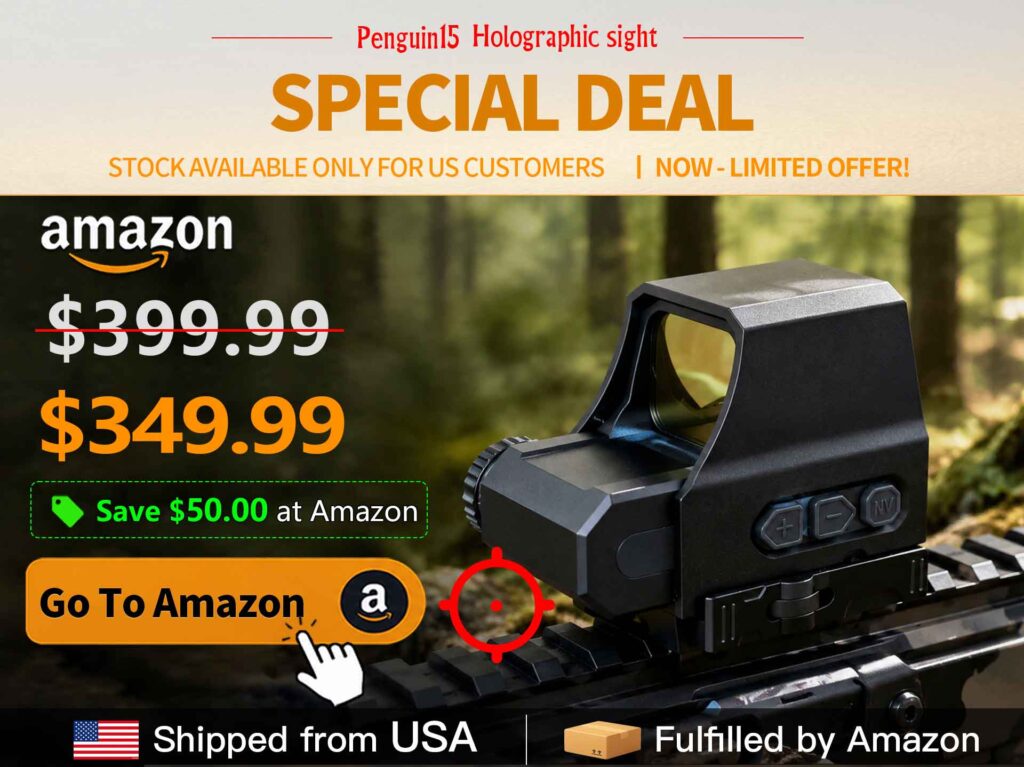
This is ultimately what buyers are paying for when purchasing a holographic sight, but now the NP-Optics Penguin15 holographic is only $349.98 on Amazon.
Winner: Depends on Your Priorities
Quick Comparison Table
| Feature | Holographic Sight | LED Red Dot |
|---|---|---|
| Parallax | Extremely Low | Low |
| Magnifier Compatibility | Excellent | Moderate |
| Durability Under Damage | Excellent | Moderate |
| Reticle Flexibility | Fixed Pattern | Multiple Patterns |
| Battery Life | Shorter | Much Longer |
| Weight | Heavier | Lighter |
| Size | Larger | Smaller |
| Cost | High | Low |
Which One Should You Choose?
Choose an LED Red Dot Sight if:
- Budget is a major concern
- Long battery life is important
- You want the lightest possible setup
- You prefer multiple reticle options
- Most shooting occurs at close range
Choose a Holographic Sight if:
- You want the best optical performance
- You frequently use a magnifier
- You value minimal parallax
- Durability is a priority
- Budget is less important than performance
My Own Shooting Experience With the Penguin15 Holographic Sight
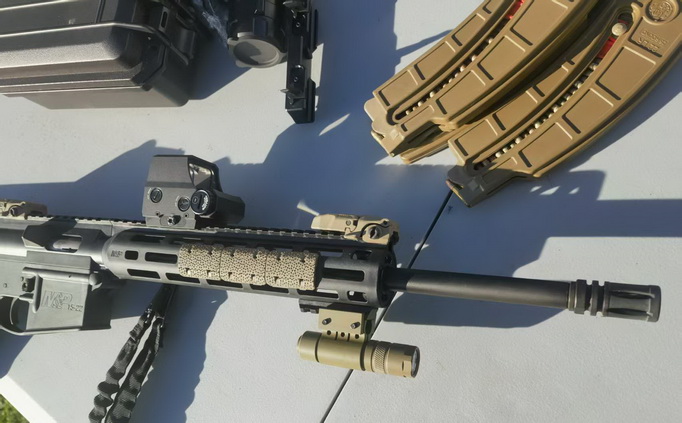
In 2024, I personally conducted live-fire testing of the Penguin15 holographic sight at a friend’s range in Huntington, West Virginia.
The test rifle was a Smith & Wesson M&P 15-22 chambered in .22LR ammunition.
Without using a magnifier, I was able to repeatedly hit a 10-inch steel target at 100 yards.
The experience taught me something important.
A holographic sight performs best when used with proper eye positioning and both eyes open. If used incorrectly, the reticle can appear to obscure the target.
However, when used as intended, the shooting experience is remarkably natural, and the accuracy at longer distances can be surprisingly good.
If budget is not a concern, I would personally choose a holographic sight without hesitation. Especially since NP-Optics Penguin15 is only about 50% cost of 600USD Eotech.
FAQ
Are holographic sights more accurate than red dots?
Both systems can be highly accurate. However, holographic sights generally offer lower perceived parallax and better magnifier compatibility, which may improve practical shooting performance.
Why are holographic sights so expensive?
Their manufacturing process requires laser projection systems, holographic film technology, precision optical calibration, and more complex assembly procedures.
Can a holographic sight work with a magnifier?
Yes. In fact, magnifier compatibility is one of the strongest advantages of holographic sights.
Are holographic sights worth it for hunting?
For hunters who value magnifier performance, durability, and advanced optical characteristics, a holographic sight can be a worthwhile investment.
Final Thoughts
The debate between holographic sights and LED red dots is not about which system is universally better.
It is about choosing the right tool for your specific needs.
For most recreational shooters and hunters, a quality LED red dot offers excellent value, long battery life, and a lightweight package.
For users seeking premium optical performance, superior magnifier compatibility, minimal parallax, and enhanced durability, a holographic sight remains one of the most advanced aiming systems available today.