
How Smart Laser Rangefinder Design Improves Thermal Scope Accuracy and Battery Life |NP-Optics Story

Modern thermal scopes increasingly rely on laser rangefinders (LRF) to improve long-distance shooting accuracy. Whether hunting coyotes, wild hogs, or predators at night, knowing the exact distance to the target is critical for making precise ballistic adjustments.

However, not all thermal scope laser rangefinder systems are designed in the same way. While many devices focus on continuous distance measurement, practical field experience shows that this approach can create unexpected problems for hunters.

In developing our latest thermal scope systems, we discovered that smarter laser activation methods can significantly improve both battery life and user experience.

Why Thermal Scopes Need Laser Rangefinders

For long-range shooting, accurate distance information is essential.

After determining target distance, shooters can use:

  • Bullet Drop Compensation (BDC)
  • ballistic calculators
  • reticle holdover references

to make proper elevation adjustments.

This becomes particularly important during:

  • coyote hunting
  • wild hog hunting
  • nighttime predator control
  • long-range shooting situations

A laser rangefinder allows the shooter to quickly identify target distance and improve shot consistency.

For many hunters, a thermal scope with laser rangefinder capability has become one of the most valuable feature upgrades.


Problems with Continuous Laser Measurement

Traditional thermal scope laser rangefinder systems often rely on an electronic switch inside the software interface.

Once activated, the laser continuously measures and updates target distance on the display.

At first glance, this appears convenient.

However, real-world hunting revealed several disadvantages.

Screen clutter

Continuous distance display permanently occupies visual space.

Important information repeatedly overlays the image, making the display crowded and distracting.

During hunting, excessive UI information can reduce visual comfort and interfere with target focus.

Increased power consumption

Laser rangefinders consume significant power.

The system repeatedly emits laser pulses and processes reflected signals.

Continuous operation means continuous energy usage.

During internal testing, we observed a measurable difference:

On the Rhino645L thermal scope:

  • Standard runtime: approximately 6 hours
  • Continuous laser mode: approximately 4.5 hours

For hunters spending long nights in the field, losing over one hour of runtime becomes a practical concern.


Why On-Demand Laser Activation Works Better

During development of our new Trike645L thermal scope, we worked closely with North American hunters.

Through repeated discussions and field feedback from coyote and wild hog hunters, we learned an important lesson:

Hunters do not constantly need distance information.

Most only require distance measurements during specific moments before taking a shot.

To address this, we redesigned the laser operation process.

Instead of activating through the software menu, Trike645L introduces a dedicated side laser button.

The system now performs:

  • single distance measurement
  • on-demand laser activation
  • reduced screen occupation
  • improved battery efficiency

Distance information appears along the edge of the user interface rather than blocking the center of the image.

This creates a cleaner visual experience and allows hunters to remain focused on the target.


Laser Rangefinder + Ballistic Calculator Integration

The optimization extends beyond simple distance reading.

When the ballistic calculator is enabled:

Pressing the laser button once can simultaneously:

  • measure target distance
  • display distance on the interface edge
  • generate a red aiming reference point
  • assist reticle baseline adjustment

This creates a more efficient shooting workflow while reducing unnecessary interface clutter.

For long-distance thermal hunting, small improvements in workflow often produce meaningful field advantages.


Continuous vs On-Demand Laser Rangefinding

FeatureContinuous Laser ModeOn-Demand Laser Mode
Battery ConsumptionHighLower
Screen ClutterMoreLess
RuntimeAbout 4.5hAbout 6h
Hunting ExperienceModerateImproved

Innovation Through Real Hunting Experience

Many product improvements begin with engineering assumptions.

However, some of the most practical innovations come directly from hunters themselves.

Through real-world feedback from North American users hunting coyotes and wild hogs, we gained valuable insight into how thermal scopes are actually used in the field.

We believe innovation comes from practice.

By understanding real hunting scenarios, thermal scope design can evolve beyond specifications and become more practical, intuitive, and hunter-friendly.


FAQ

Does a laser rangefinder reduce thermal scope battery life?

Yes. Continuous laser ranging requires repeated laser emission and signal processing, which increases power consumption.

Is a thermal scope with laser rangefinder worth it?

For long-distance hunting and predator control, accurate distance information can significantly improve shooting precision.

Why use on-demand laser measurement?

On-demand measurement reduces unnecessary battery use and keeps the display cleaner during hunting.

shop at amazon for EPS-A1 battery compartment

How Does 18650 Batteries Work with Thermal Scope? | NP-optics Guide

With the development of technology, the performance of thermal scopes has advanced rapidly in recent years. Larger infrared detector arrays, more powerful image processing algorithms, more complex functions and UI interfaces, and larger display screens — all these technological upgrades that bring hunters a more comfortable experience are actually power-hungry. A larger infrared sensor array means more signal data; a clearer image means more precise calibration and collection of more parameters such as XYZ axes; a larger display also requires more power. All of this puts pressure on battery life.

The 18650 lithium-ion battery is the most common power source for thermal scopes. The 18650 covers all lithium batteries with a diameter of 18mm and a length of 650mm, and the capacity of these batteries varies widely based on our years of experience. Today, we took several common types of 18650 batteries and tested them. Our experimental data shows that the approximate capacity of these batteries ranges from 980mAh to 3300mAh. In particular, a battery labeled as 9800mAh showed extreme false advertising, with a true capacity of only 980mAh. We recommend that you do not trust exaggerated marketing claims and instead choose certified 18650 batteries with a stated capacity not exceeding 3300mAh.

How long can a thermal scope run on two 18650 batteries?

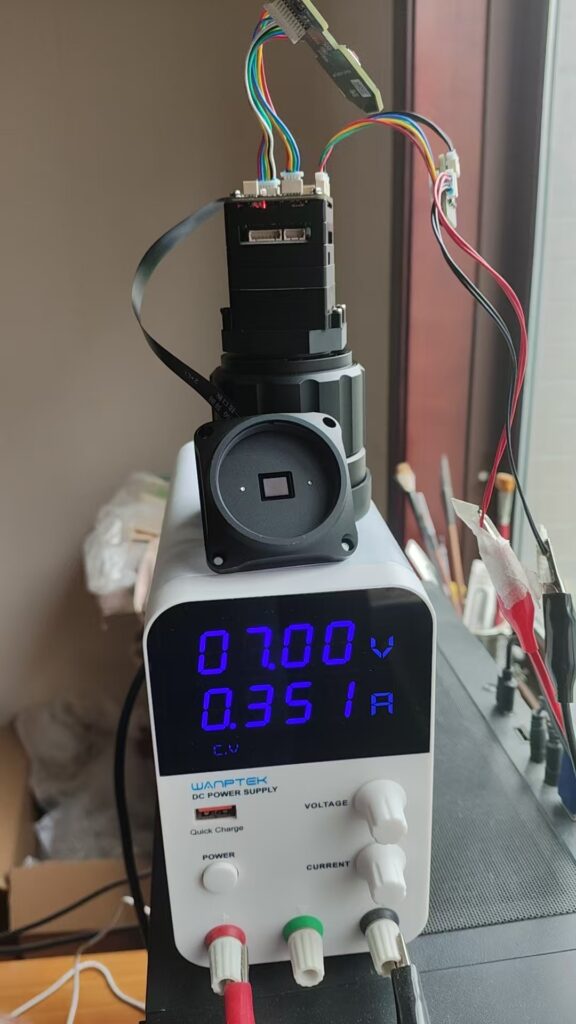
When testing the power consumption of various thermal scope models, we found that most 384×288 resolution thermal cores consume about 1.8W, while most 640×512 resolution thermal cores consume about 2.2W. The average voltage of an 18650 battery is U=3.7V. Two 3000mAh 18650 lithium batteries can support a 640 thermal scope for approximately 8 hours, while a 384 resolution thermal scope can run for more than 10 hours.

thermal detector power rating

What factors affect battery life?

  1. At lower temperatures, lithium battery capacity is greatly reduced. At 0°C, capacity is about 75% of room temperature capacity; at -10°C, it drops to about 55%; at -20°C, it reaches only about 40% of the rated capacity. This is why when we hunt in the early morning hours of winter, even with two batteries, a thermal scope may only work for 4 to 5 hours.
  2. More complex temperature changes cause thermal scopes to perform calibration more frequently. Sometimes, the smaller the temperature difference in the background, the weaker the signal reaching the infrared detector, and the more noise there is. To reduce noise, the thermal scope performs more calculations and processing. These factors increase power consumption and shorten battery life.
  3. Frequent use of the laser rangefinder and ballistic calculator requires a large amount of power to emit the laser and compute impact point parameters. This is one of the largest power demands among all UI functions.
  4. Electronic compass. Today’s thermal scopes commonly come with a six-axis electronic compass (gyroscope). The electronic compass operates continuously, and turning it on increases overall power consumption by about 0.2 to 0.3W.
  5. Brighter LED display. For a display with the same resolution, power consumption rises and falls with brightness. We do not recommend that shooters always keep the brightness at maximum when using a thermal scope. On one hand, it increases power consumption; on the other hand, after the user’s eyes leave the screen, it takes longer to readapt to the ambient darkness.

Suggestions to extend your battery life of thermal scope: use external power supply devices like EPS-A1 rifle mounted battery compartment can effectively extend your thermal scope running time by 4~6hours!

shop at amazon for EPS-A1 battery compartment

A buying guide for 384 Vs 640 thermal scope | NP-optics Guide

When choosing a thermal scope, many hunters only look at the resolution numbers but do not understand the meaning behind those numbers. As a result, they often find themselves struggling over the “384 vs 640” question. Today, we are here to give you a complete and correct explanation of thermal scope resolution once and for all, so that you can get a clear answer based on your own needs.

First, we need to understand that numbers like 640×512 and 384×288 represent infrared detectors with different array sizes. Based on optical principles, each has its own strictly defined optimal application scenario. If you choose the wrong parameters, a hunter will either spend extra money on a high-end configuration that they cannot make use of, or pick a lower-end one that fails to achieve the desired long-distance requirement. Below, we will explain the principles clearly, and then use the real-world cases of two customers to give you the best guide for choosing between 384 vs 640.

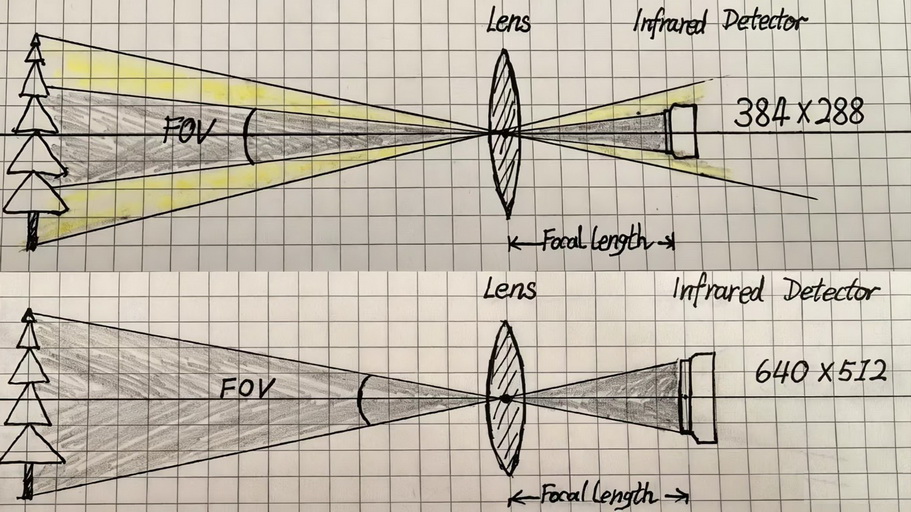
To make it easier to understand, we have created an optical path comparison diagram. The upper and lower paths show how a 384×288 detector and a 640×512 detector perform at the same target distance and with the same objective lens focal length — specifically, their FOV performance and signal reception.

At the same focal length, the 640×512 detector array at the bottom can fully receive all the light signal projected by the distant target through the objective lens. In contrast, the effective area of a 384×288 detector is only about half the size of the 640×512 detector, so it can only capture part of the light signal projected by the target. More of the light signal, after passing through the objective lens, falls outside the 384×288 array. In other words, pairing a small detector with a large lens is a waste. The role of lens focal length is very direct: the longer the focal length, the higher the magnification and the stronger the long-range detail resolution, making it suitable for locking onto small targets at ultra-long distances; the shorter the focal length, the wider the field of view, making it faster for close-range scanning and more flexible for tracking. However, the lens must be perfectly matched with the corresponding detector resolution in order not to waste optical performance.

On the question of how to choose between 384 and 640 thermal scopes, two of our users made completely different choices.

Tommy lives in Virginia and has four years of coyote hunting experience. He hunts year-round in the hilly, densely forested areas of the Appalachian Mountains, where there is a lot of terrain obstruction and his effective shooting distance is consistently within 200 meters. All his shooting techniques and habits are built around short-range precision. He told me that for shooting needs within 200 meters, the pixel density of 384 resolution is completely sufficient—the image is clear with no pressure, and there is no need for a higher pixel count. Paired with a 35mm or 42mm standard focal length lens, it perfectly matches the small array of the 384, utilizing 100% of the lens performance. The field of view is suitable for fast searching in dense woods, the body is lighter, and the battery life is longer. Within a 200-meter shooting range, there is no noticeable difference in image quality between a 384 setup and a 640 setup. Choosing 640 would be completely overkill and unnecessary expense. Therefore, he chose our Rhino335L thermal scope and is very satisfied with it.

Now look at Bob, who also has four years of hunting experience, but his scenario and needs are completely different. Bob hunts wild hogs on the open plains of Texas — no obstruction, wide-open FOV, and 300 to 400 meter long-distance shooting is routine for him. He told us that the core needs for killing wild hogs in Texas are to see far, identify clearly, and lock onto target details at long distances. At this distance, the inherent shortcomings of the 384 detector cannot be overcome. Even if forcibly paired with a long focal length lens, the array size is too small, wasting lens performance. The long-distance image becomes pixelated, target outlines are blurry, and details cannot be judged, directly affecting hit probability. The larger sensing array of the 640 detector can perfectly match a long focal length lens, fully receiving all the imaging light from the lens and fully utilizing the long-distance resolving power of the long lens. At distances of 300 to 400 meters, it still delivers a sharp and detailed image, allowing precise locking onto the silhouette and posture of a coyote. For Bob, 640 product like our Rhino645L is not a premium up-sell; it is a necessity for long-distance hunting. No matter how large a lens you pair with a 384 setup, it cannot meet his real-world needs.

To sum up: for short distances, use 384×288 paired with a short focal length lens — best value, practical and sufficient. For long-range open plains, choose a long focal length lens paired with a 640×512 infrared detector — you can see far and have a wider field of view(FOV). Now, on this question of 384 vs 640, do you have your answer?

Choose 384 If:

  • budget limited
  • short range hunting
  • beginners

Choose 640 If:

  • long distance hunting
  • professional predator control
  • better detail needed

Please enter your info and let's start chatting!